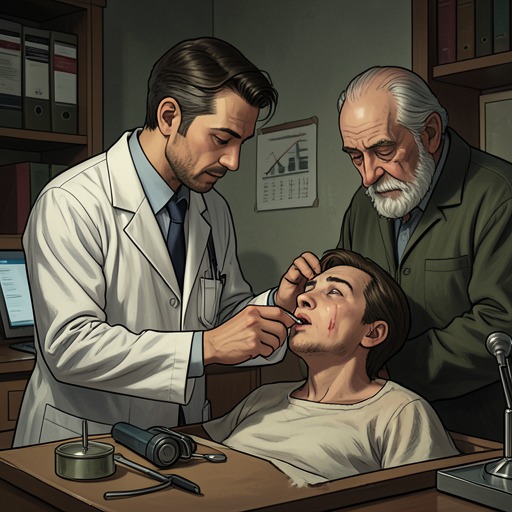
Hohsalle—Limuelle
The Deer KingHohsalle—Limuelle describes the bond between Hohsalle and his grandfather Limuelle as both a family relationship and a medical inheritance. Limuelle trained Hohsalle in Otawalle medicine, and their successful treatment of the Zolian emperor’s wife made their work famous while intensifying the conflict between medical investigation and religious doctrine.
Family and Medical Apprenticeship
Limuelle was Hohsalle’s grandfather and a renowned physician. Hohsalle trained under him, and his talent emerged early: he began teaching at the Otawalle Academy of Deeper Learning at fifteen. By twenty-six, he directed the research wing of the academy’s Institute of Medicine and was known throughout the Zolian ruling class. His reputation rested in part on work alongside Limuelle, but Hohsalle had also saved many other people from mortal injury and disease.
Their medical partnership had reached the Zolian court when Emperor Natalu’s wife fell gravely ill. Natalu summoned Limuelle and Hohsalle despite advisers’ objections to Otawalle remedies, which they regarded as heretical. The two physicians cured the empress. Natalu then asked them to remain as palace physicians and teach the priest-doctors Otawalle medicine; they declined, but the episode brought the reach of their medical knowledge to the attention of the empire’s aristocracy.
Shared Work and Conflicting Medical Principles
The court’s reaction reflected a deeper divide. Under the Pure Heart Creed, Zolian priest-doctors were regarded as religious authorities, and incurable patients were generally left in the hands of the god rather than treated in an effort to extend life. Limuelle and Hohsalle’s cures offered another course: investigate disease and pursue healing even when established authorities judged recovery impossible. Although nobles covertly sought Otawalle physicians, its medicine remained officially branded heresy a decade after the empress’s recovery.
Hohsalle’s investigation of black wolf fever shows the practical character of the training he inherited. Examining the dead workers at the salt mine, he identified dog bites and widespread rashes; he also explained that the disease could spread through wolves, wild mountain dogs called ossam, and fleas or ticks that had bitten infected hosts. Limuelle and Hohsalle’s work therefore joined close observation of evidence to questions about transmission and possible treatment.
The research program they shared looked beyond diagnosing the outbreak. Hohsalle’s colleague Milalle explained that the bodies could hold disease agents useful for developing a weakened infection to build resistance, substances that might suppress or eliminate the disease, or antibodies that could support a serum. Later, Hohsalle described the body’s defenses as different kinds of soldiers that must learn to recognize disease agents. He credited Limuelle with discovering why some diseases are contracted only once and devising a way to introduce weakened agents into the body. The account links Hohsalle’s explanation directly to his grandfather’s discovery.
Inheritance and Institutional Conflict
The relationship also encompasses a disagreement that neither family affection nor medical success could simply resolve. Hohsalle had long dealt with the priest-doctors and had understood their opposition largely as a struggle over authority. A conversation with one of them revealed a more fundamental divide: Pure Heart Creed medicine did not consider identifying the causes of disease necessary. Its practitioners sought to recognize and remove what appeared as defilement in the patient, rather than investigate the agents responsible. Hohsalle realized that the two systems differed at their roots, and that priest-doctors would not agree to inoculation as a means of prevention.
Limuelle’s response to that divide gives their shared work its clearest statement of purpose. He argued that studying the disorder of the world, aspect by aspect, was necessary for new knowledge, and that Otawalle physicians would not give up on patients or ask them to give up. He also saw practical consequences in winning priest-doctors’ cooperation: it could free Otawalle medicine from institutional restraints, bring it more funds and personnel, and spread its knowledge across Zolian society. He encouraged Hohsalle to invite a priest-doctor to assist with treatment again, turning their inherited medical practice toward collaboration without surrendering its commitment to investigation.